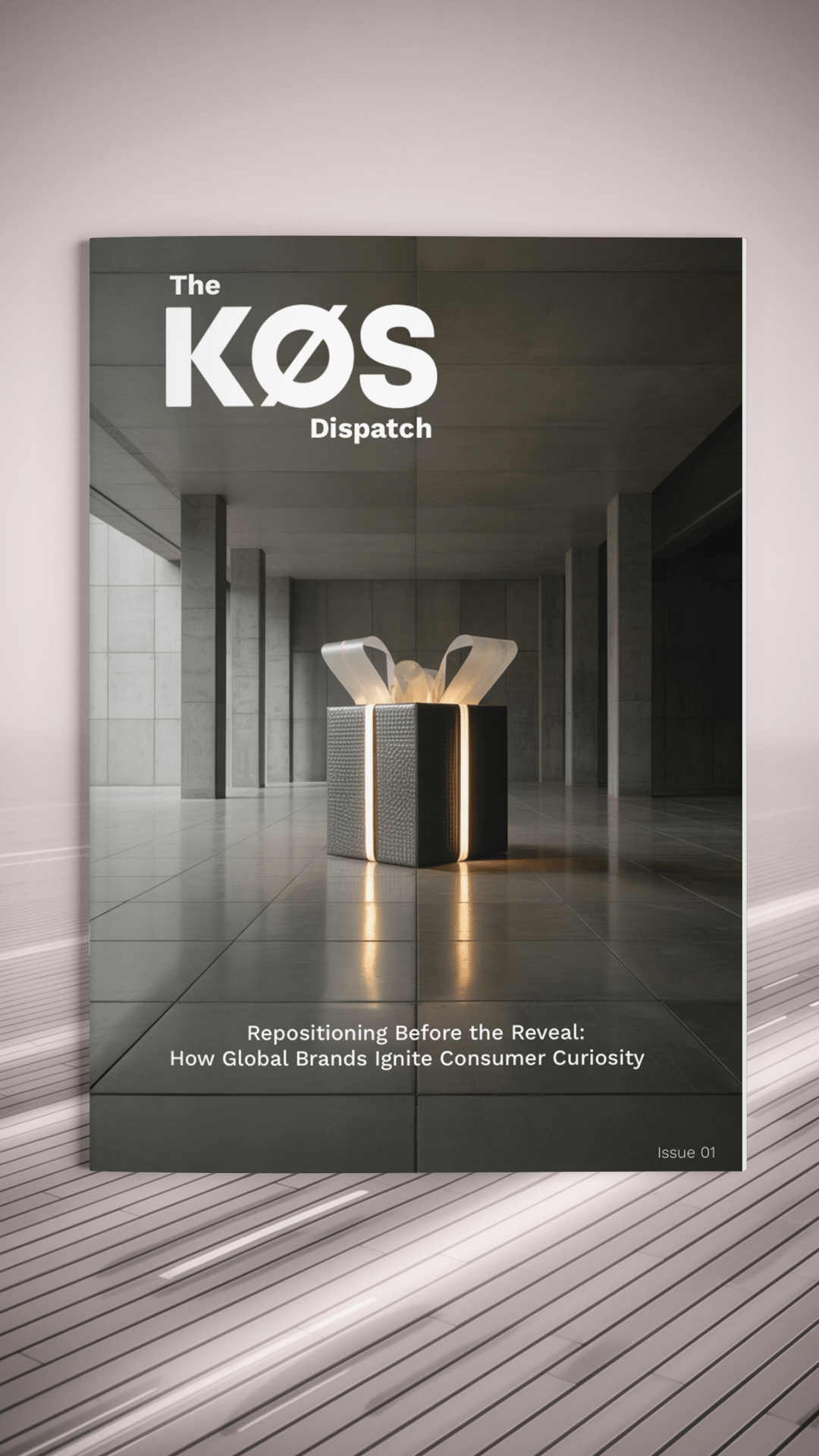
Letter from the Editor
There are moments in life when you feel the rules no longer apply. When the frameworks, formulas and filters we have been handed feel outdated.
KØS was born in one of those moments. Not as a company, but as a revolt. A rebellion against templates. Against beige thinking. Against the notion that strategy and creativity must live apart.
KØS is not about answers. It is about better questions. It is about pushing boundaries, breaking the expected and creating things that make people feel something. It is a lab for disruptive ideas. A sanctuary for brand misfits, innovation lovers and experience makers.
And The KØS Dispatch? It is our monthly transmission to the world. Our signal from the edge.
This is not another industry report filled with jargon and recycled trends. It is a living, breathing document, part observation and part provocation, written for those who think differently, obsess over originality and believe business should stir the soul, not just the numbers.
Why now? Because the future is happening faster than most brands are ready for. Because in a world of noise, presence is everything. Because the most valuable currency today is attention and how we earn it is the art form of our time.
This first issue explores one of the questions that haunts visionary brands:
How do you get into people’s minds before you ever ask them to open their wallets?
Spoiler: it takes much more than a logo.
Welcome to The KØS Dispatch.
Welcome to What is The Future.
David Leuchter
Founder and Strategic Designer, KØS
Introduction
In a crowded marketplace, successful brands know that a bold relaunch is not announced with a whisper, it is preceded by a crescendo. Before unveiling a new visual identity or product, innovative companies build awareness and emotional connection so that consumers are primed and excited when the reveal finally comes.
This approach, similar to a prelude before a grand symphony, involves creative tactics that range from immersive pop up experiences to influencer fueled storytelling. The following case studies explore how globally recognized, culturally influential brands sparked curiosity and strengthened their presence in consumers minds ahead of a rebrand or product update. Each illustrates a strategic, bold and creatively charged campaign that not only generated buzz but also delivered tangible results.
Chapter 1: Rimowa
From Heritage Luggage to Hype Worthy Lifestyle Brand
Founded in 1898 and long known for German engineered aluminum suitcases, Rimowa undertook a dramatic repositioning after luxury group LVMH acquired a majority stake in 2016. Under the leadership of Alexandre Arnault as co CEO, Rimowa modernized nearly every facet of its brand, from store design and product strategy to branding and marketing, to shift from a staid baggage maker to a cultural icon.
One of the first moves was making retail more experiential. Rimowa opened a sleek Paris flagship and its first pop up store on Rodeo Drive, replacing its formerly very white and very old fashioned shops with a contemporary, more experiential concept to engage younger shoppers. This physical refresh went together with a new visual identity. A refreshed logo and monogram for the one hundred twentieth anniversary projected a distinctive and contemporary image as striking as its suitcases.
Beyond aesthetics, Rimowa injected cultural energy through collaborations and storytelling. The brand expanded the breadth of its collaborations as a sure fire way to resonate with easily bored millennials. To celebrate the eightieth anniversary of its aluminum luggage line, Rimowa enlisted artists and designers such as Virgil Abloh and Karl Lagerfeld to personalize suitcases, creating one off pieces that blurred art and travel gear.
Soon after, collaborations with buzzy brands followed. A capsule with Supreme had fans lining up around the block, and a partnership with Fendi put a Rimowa case on the runway, flooding social media with images of modern yet elegant luggage. Rimowa’s tone shifted toward high fashion, featuring influencers like Bella Hadid and creatives in content that emphasized a lifestyle of purposeful travel. By associating its suitcases with style icons and jet set storytellers, Rimowa built intrigue among a new generation of consumers who started to see the brand as cool and aspirational, not just functional.
This all culminated in 2018 with Rimowa’s Never Still campaign, a global storytelling initiative timed with its one hundred twentieth anniversary. The campaign assembled a cast of cultural icons who were genuine Rimowa users, including Roger Federer, Virgil Abloh, Adwoa Aboah, Nobu Matsuhisa and Yoon Ahn. Each shared a personal journey in a short film around the line no one builds a legacy by standing still.
By celebrating ambition and resilience through travel, Rimowa tapped into emotional storytelling that went beyond product. The campaign rolled out on the icons own Instagram accounts first, leveraging their massive audiences, and then expanded across Rimowa channels, paid media, cinemas, airline entertainment and outdoor. The orchestrated buzz reached more than fifty million people in two weeks, with video completion rates far above industry averages and hundreds of millions of earned impressions. Web traffic jumped, social engagement spiked and organic visits rose by triple digits.
Rimowa succeeded in making itself unforgettable right before introducing its refreshed logo and stores. By the time new products or retail concepts arrived, consumers already perceived Rimowa as a revitalized, culture savvy luxury brand. The Rimowa story shows how pop ups, high fashion collaborations and narrative campaigns can reposition a heritage brand in consumers minds, marrying legacy with buzz so a relaunch lands with maximum impact.
Chapter 2: Loewe
Crafting a Cultural Renaissance in Luxury Fashion
While Rimowa leaned on street culture, Loewe, the Spanish luxury house founded in the nineteenth century, engineered a renaissance rooted in art, craft and modern design. When Jonathan Anderson took over as Creative Director in 2013, he faced the task of shaking off Loewe’s image as a faded leather maker and turning it into a trendsetting luxury leader.
Anderson’s strategy was bold and experimental yet respectful of Loewe’s artisanal core. Before rolling out new products, he focused on building awareness and cultural capital around values such as heritage, craftsmanship and an avant garde artistic vision so that consumers would be ready to embrace Loewe’s new direction.
One of his first moves was to refresh Loewe’s visual identity in a way that would spark curiosity. In June 2014, months before his debut collection, the brand unveiled a new logo and branding created with M M Paris. This twist on the classic anagram signaled that something new was coming and fashion watchers took it as the first hint of Anderson’s vision.
He then launched a striking campaign shot by Steven Meisel for Spring and Summer 2015, a radical departure from Loewe’s past glossy ads. The campaign repurposed an iconic 1997 image and gave it a pared back, artsy look, unlike previous celebrity led campaigns. Anderson said that Loewe did not have to be about fashion only, it had to be about a cultural landscape. Positioning Loewe as a cultural brand rather than only a fashion brand set the stage for consumers to view it as a curator of art, design and ideas.
This repositioning came to life through storytelling and partnerships that built presence beyond the runway. Loewe’s advertising started featuring narratives and imagery that highlighted craft. A campaign titled Either Way spotlighted artisanal techniques. The brand also began collaborating with artists and cultural institutions, strengthening its image as a patron of the arts, including projects with Japanese contemporary artists and a capsule collection with Museo del Prado in Madrid. These efforts introduced Loewe to audiences who valued the fusion of fashion, art and culture.
Experiential initiatives deepened emotional connections before any formal rebrand. A prime example is the Loewe Foundation Craft Prize, founded in 2016 to honor artisans in fields like ceramics, weaving and jewelry. Thousands of craftspeople apply each year and Loewe hosts exhibitions of finalists works in cultural capitals. The prize aligns Loewe with the preservation of craft and, in Anderson’s words, puts artisans forward so the brand does not have to speak. It has drawn designers, art curators and cultural figures, reinforcing Loewe as a pioneer in presenting a modern vision of luxury fashion and culture.
Over Anderson’s tenure, Loewe transformed from a sleepy label into one of LVMH’s fastest growing brands. Revenue surged, profits climbed and pieces like the Puzzle bag became icons with waitlists. Loewe’s quirky shows and artist collaborations routinely dominated social media.
By focusing on presence, cultural relevance and emotional resonance before pushing product, Loewe reintroduced itself to the world. The story illustrates that repositioning in luxury is not about a new logo alone. It is about earning a place in consumers hearts and minds through creativity and authenticity so commercial results follow naturally.
In March 2025, Jonathan Anderson stepped down as Creative Director of Loewe.
Chapter 3: Jacquemus
Whimsical Experiences and Viral Moments to Build Hype
In contrast to century old houses, Jacquemus is a younger brand founded in 2009 that has punched above its weight by mastering creative marketing. Without the budgets or heritage of large luxury groups, Simon Porte Jacquemus leaned on originality to make his brand memorable long before shoppers reached the checkout.
His approach can be described as surrealist marketing, using fantasy, humor and immersive experiences to captivate the social media generation. By the time Jacquemus launches a product or enters a market, consumers are already attached to the brand world. Revenues doubled to more than two hundred million euros by 2022 and are on track to grow further, with no traditional marketing team, which shows that creativity itself has been his growth engine.
A core element of Jacquemus pre launch strategy is creating experiential events that generate online buzz. His runway shows are legendary. Models have walked a long pink carpet cutting through lavender fields in Provence, a dream like salt flat and even the grounds of Versailles. The shows are often invite only, in breathtaking locations, and designed to be highly photogenic. Each setting provides a backdrop for images and video that travel globally, letting millions who were not there share the experience.
Jacquemus extends this magic to retail with themed pop up stores that blur shopping and entertainment. His pop ups have become topics of conversation on their own. The pop up worked so well that he replicated the idea in other cities, including a white version in Milan. Other pop ups in places like Lake Como and the French Alps turned retail into a travel postcard. These visual playgrounds generate user content and organic reach, giving Jacquemus exposure and cool factor without traditional ads.
Another clever tactic is leveraging social media virality through whimsical stunts. One campaign showed oversized Le Bambino handbags on wheels moving through Paris like driverless cars. The video had viewers worldwide asking if it was real and racked up millions of views. In another case, Jacquemus placed a giant pink handbag sculpture on a city bus and installed playful pieces inside his boutique, such as a bag shaped popcorn machine.
These unexpected visuals, usually unveiled on Jacquemus’s own channels, prompt sharing. The brand’s content often earns hundreds of thousands of interactions. Jacquemus also embraces the power of modern supermodels and celebrity influencers, casting figures like Kendall Jenner and Gigi Hadid and relying on paparazzi moments to expand reach.
The effectiveness of this hype machine shows up in both metrics and business outcomes. The brand’s growth and global expansion have outpaced many competitors and it has built a loyal community of fans who feel emotionally invested. They are not just buying objects, they are buying into a lifestyle of sunny escapism, playful luxury and creativity for its own sake.
By consistently surprising and delighting people before asking for their money, Jacquemus shows how a challenger can use storytelling, experiences and virality to build awareness and anticipation. The lesson is clear: if you can capture imagination, you have won half the battle before your product arrives.
Chapter 4: Apple
Think Different and Storytelling a Brand Comeback
Not all pre launch campaigns rely on spectacle. Some, like Apple’s Think Different, focus on brand storytelling and values to set the stage for a strategic pivot. In 1997, Apple was in crisis, with declining market share and financial losses. Steve Jobs, returning as chief executive, knew that before Apple could debut new products such as the iMac, it had to rebuild public belief in the brand.
Think Different was created as an exercise in selling Apple’s why, not its what. Launched in the fall of 1997, a year before the iMac release, the campaign avoided talk of computers or specifications. It featured black and white imagery of historical figures who challenged the status quo, from Albert Einstein and Mahatma Gandhi to Amelia Earhart and Pablo Picasso. Each ad honored the crazy ones, the misfits and the rebels, implicitly casting Apple as the brand for creative thinkers who dare to be different.
The message created emotional resonance and curiosity at a time when Apple had no major product news. The campaign launched with a one minute television spot during a prime time airing of Toy Story in 1997 and quickly drew attention. Print and billboard ads followed, placing these portraits and the line Think Different across cities. Apple even sent poster sets to schools, seeding a generation with the imagery.
This was aura building, aligning Apple with genius and creativity. Buying an Apple computer started to feel like an expression of creative identity rather than just a purchase. The campaign also rallied employees around a renewed purpose. Apple turned the narrative from a struggling tech company into a visionary underdog returning to change the world.
The impact was measurable. Within months, Apple’s favorability improved and sales stabilized even before new products arrived. By April 1998, Apple reported its first profitable quarter in two years and executives credited the campaign for helping drive demand. Customers who had been wary returned and market share started to recover.
Think Different also received cultural recognition. It won awards, including an Emmy for best commercial and a Grand Effie for effectiveness. The style and line remain instantly recognizable decades later, proof of how deeply it shaped Apple’s renewed identity.
The campaign is now a textbook example of brand led repositioning ahead of product innovation. By communicating a clear philosophy that celebrated creativity and nonconformity, Apple rebuilt emotional connections so that when new products arrived, people were ready to see them as expressions of that philosophy, not just gadgets.
Chapter 5: BMW
Cinematic Storytelling and the Art of Tease
In 2001, BMW chose an unconventional route to spark interest in its cars. The company became a short film studio. Years before content marketing was a trend, BMW produced The Hire, a series of short films, as a way to reposition its image and excite consumers ahead of new model launches.
The premise was simple and radical for its time. Instead of traditional ads focused on performance claims, BMW created entertainment. Eight cinematic shorts, each around six to ten minutes, followed a mysterious driver played by Clive Owen as he took on missions in different BMW models. The films were directed by well known filmmakers such as Ang Lee and Guy Ritchie and featured actors like Madonna and Don Cheadle.
The cars were integral characters in the stories. Their style and performance showed up through chase sequences and stunts rather than explicit sales language. By framing BMWs as the ride of choice for a capable, cool hero, the brand crafted a powerful mystique.
The rollout built intrigue in the months before new models hit showrooms. Initially launched on BMW’s website in April 2001, the films were promoted like movie releases, with trailers, teaser posters and a festival premiere. BMW shifted its budget toward production and relied more on the films themselves to drive attention, a risk that paid off.
The Hire became an early viral success of the broadband era. Millions of people streamed or downloaded the films at a time when that behavior was still new. Media coverage amplified the buzz and DVDs of the series even reached fans who wanted to own the content.
Beyond conversation, the project contributed to sales momentum. The second wave of films in 2002 aligned with the launch of the Z4 roadster. Instead of loud product ads, BMW let the car play a starring role in one of the stories, building desire through association. During this period, BMW recorded strong sales growth and outperformed some competitors.
The Hire won top advertising awards and effectiveness prizes, proving that it did not just entertain, it helped sell cars. BMW redefined itself in the process, shifting from a brand known only for driving machines to a brand at the intersection of luxury and culture.
The genius of the project lay in understanding suspense and soft selling. By not immediately showing new models in detail, BMW teased audiences and made them eager to learn more. It nurtured an emotional connection before any direct sales proposition and tapped into the influence of directors and actors as cultural figures.
Key Takeaways: Crafting an Effective Pre Rebrand Campaign
From luxury luggage and couture to technology and automobiles, these cases share common threads that can inform any pre launch strategy.
Lead with story, not specifications.
Each brand focused on emotional storytelling or cultural narrative before pushing products. Apple celebrated creativity instead of computer features and BMW entertained rather than listing performance claims. A compelling story gives people a reason to care.
Create experiences that spark conversation.
Jacquemus shows, Rimowa pop ups and cinematic projects like The Hire generate moments that people want to share. Experiences serve as touchpoints that make brands feel present in everyday life, not only when a product is for sale.
Leverage influencers and cultural icons in an authentic way.
Rimowa partnered with genuine brand fans such as Roger Federer and Virgil Abloh and Loewe collaborated with artists and institutions that fit its craft centric identity. These relationships lent credibility and relevance because they aligned with core values.
Build curiosity with mystery and selective access.
Pre launch campaigns should invite questions. BMW’s films made viewers want to know more about the cars and Jacquemus limited events created a fear of missing out that fueled intrigue. Revealing just enough to entice audiences can be more powerful than over explaining.
Stay true to brand DNA while amplifying it.
Loewe leaned into craft, BMW into driving excitement and Apple into creativity. Each used new formats and bolder expressions to re engage people, but the core identity remained intact. Repositioning works best when it grows from authentic strengths rather than gimmicks.
A strategic and creatively charged pre rebrand campaign primes the market psychologically. It energizes existing fans and often attracts new ones who were not paying attention before. Done well, it turns a relaunch from a moment in time into a cultural event.
By the time the new logo appears or the new product drops, consumers already feel connected to the story and want to be part of the next chapter.
kos.wtf · @kos.is.now · hello@kos.wtf