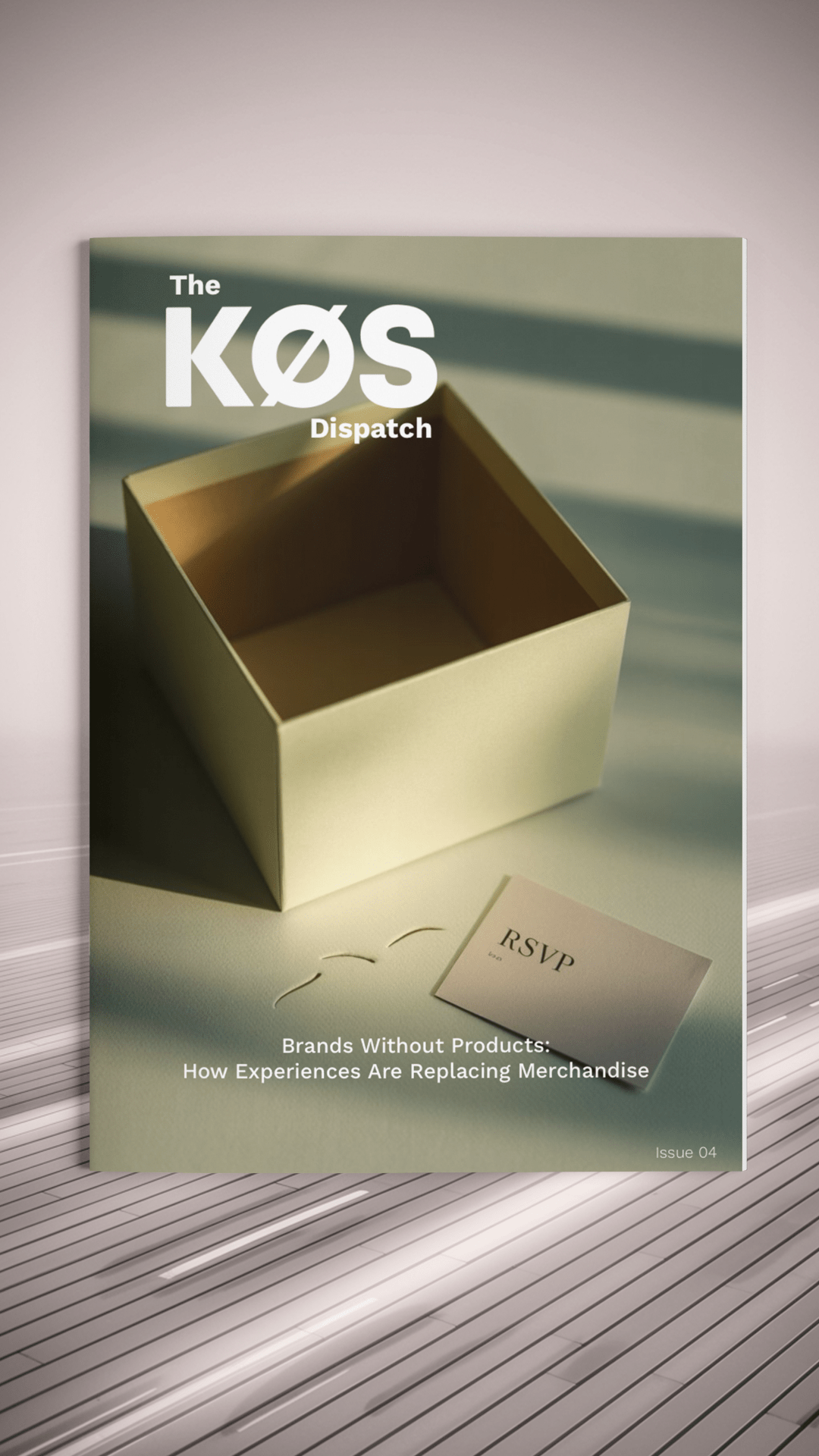
Letter from the Editor
When we launched The KØS Dispatch, we made a quiet promise, to question what others take for granted.
This issue is that promise, set on fire.
In a world obsessed with selling things, we are far more interested in what makes people feel. No matter how shiny the product, the real value lives in what surrounds it, the anticipation, the memory, the belonging. Brands without products is not a prediction. It is already here.
From hospitality houses born from fashion labels to cult fitness studios that sell nothing but adrenaline and identity, we are watching brands abandon the shelf and embrace the stage. Not because they have to. Because they understand what is truly scarce. This new era is not about selling more. It is about meaning more.
This edition is a map, a manifesto and maybe a mirror. You will not find best practices here. You will find provocations, patterns and possibilities. Read it like a playbook. Or like a spark.
See you at the edge.
David Leuchter
Founder and Strategic Designer, KØS
What’s the Future?
Introduction
The hottest thing your brand can sell today is not a product. It is a feeling. In an age where a huge share of consumers say they prioritize experiences over things, global brands are flipping the script. Shoppers are not lining up only for the latest gadget or handbag. They are lining up for the immersive pop up, the secret menu speakeasy, the festival style product launch.
The result is a shift from product centric strategies to experience first ecosystems, where memory beats merchandise. We are entering a world of brand theaters, digital dreamscapes and lifestyle havens. A world where the store is the stage, the customer is the star and the product is just one part of the plot.
Chapter 1: From Product Led to Experience First
A Brief Evolution
Not long ago, branding revolved around the product. Quality, consistency and a catchy slogan were enough. Customers were told what to buy. Marketing was a one way street of features and benefits.
Over the past few decades, tectonic shifts in consumer values have pushed us into what many call the experience economy. Classic business thinkers illustrated this with a birthday cake. Our parents once baked cakes from scratch for almost nothing, then bought grocery cakes for a modest price, and now families pay high premiums for themed birthday parties that stage a memorable event, cake included. The point is simple. People are willing to pay more for the experience around a product, not just for the product itself.
Today, quality on its own is not enough. Goods have been commoditized and digital technology has armed consumers with infinite choice. To stand out, brands cultivate emotional resonance and human connection. Many people would rather hold onto a unique memory than a unique commodity. We have moved beyond the era of better mousetraps. Now it is about the better moment. Brands that once sold an item now sell a lifestyle and an identity.
Several forces accelerated this pivot. The rise of millennials and Gen Z has been crucial. These generations often treat experiences as status symbols. Baby boomers flaunted watches or cars. Younger consumers show their status by posting about exclusive and meaningful experiences that can live on their feeds. A luxury camper trip under the stars or a VIP pass to a festival is today’s badge of honor, more than any logo on a handbag.
Add a pandemic, which reminded us what we missed when experiences disappeared, and a digital landscape that makes every moment shareable in real time, and you have a perfect storm. In this climate, experiences sit at the top of the value chain. Brands that ignore that reality do it at their own risk.
Chapter 2: The Rise of Experiential Value
Why It Matters
The shift to experience first branding is not a passing trend. It is grounded in business results and in human psychology. Emotionally engaging experiences create deeper loyalty than any product spec sheet. Memorable moments stick. Fleeting, swipe style relationships do not.
There is hard return here. Companies that excel in customer experience consistently see higher revenue growth than those that treat experience as an afterthought. Experiential marketing can directly lift sales. Brands that embrace live events, tactile demonstrations and immersive media often see conversion rates jump dramatically after the experience. Make someone feel something and you have a far better chance of making them a customer.
Three drivers explain this value shift. The first is human connection. Experiences tap into joy, awe, nostalgia and belonging in ways that products alone rarely can. A luxury store or hotel that treats you like a true guest, or a tech brand that delights you with a little augmented reality magic, changes the way you feel about that brand.
The second driver is social currency. In the Instagram and TikTok era, experiences are ready made content. A stunning pop up installation or quirky event can spark free viral exposure as attendees broadcast it to their networks. If it is not on the feed, did it even happen. Brands now know that storyliving beats traditional storytelling. It is not enough to tell a great brand story. You need to invite people to live it.
The third driver is community. Experiences bring people together, turning customers into fans and fans into tribes. An online forum of gamers, a runners’ club led by a sportswear brand or a hotel chain’s members only events all create interactions between customers that the brand hosts. Those bonds outlast any single purchase. The brand becomes something lived with others, not just a label on a box.
The net effect is a shift in perception. The brand stops being a logo and starts being a meaningful part of a life. When that happens, price and features become supporting details. The experience is the real asset.
Chapter 3: Luxury and Hospitality
From Status Symbols to Storyliving
In the luxury world, the product used to be the unquestioned hero. The couture dress, the Swiss watch, the Italian sports car. That picture is changing quickly. The brands setting the pace now understand that they are in the business of selling dreams, not just items.
That is why so many luxury labels have expanded into hospitality and lifestyle experiences. Armani and Bulgari operate hotels in Dubai and Milan. Cartier and Tiffany run cafes where you can literally have breakfast at Tiffany’s. Ralph Lauren has restaurants and coffee shops in New York and London. A Swiss watchmaker like Audemars Piguet has invested in a boutique hotel in the Alps. The logic is clear. Let customers live the brand, not only wear it.
Younger affluent consumers drive this evolution. They want to live and experience their beloved brands beyond simple ownership. Luxury is shifting from a trophy in your garage or on your wrist to a world you can walk into. By moving into hotels, restaurants, private clubs and branded residences, luxury houses allow fans to inhabit the brand universe around the clock. A hospitality analyst summarized it simply. Hotels and restaurants let guests be fully immersed in their favorite luxury world.
This is not just about flair. These ventures deepen emotional bonds and lifetime value. Sharing a Dior inspired gourmet picnic or attending a Chanel art exhibit creates memories that ordinary money cannot buy. Those memories then justify the money that can buy the goods. The product becomes the souvenir. The real luxury is the story you lived.
Luxury brands have moved from storytelling to what many call storyliving. They no longer only narrate heritage and craftsmanship in glossy campaigns. They stage moments you can touch, taste and share. The strategy is working. Younger luxury buyers respond with intense loyalty to brands that give them experiences aligned with their values and lifestyle. When a house hosts you at a pop up retreat or on a private journey, think of Louis Vuitton organizing a bespoke train voyage for top clients, it creates an emotional halo around every purchase that follows.
In effect, luxury marketing is mutating into hospitality. The ultimate luxury today is not simply owning something exquisite. It is feeling part of something exquisite.
Chapter 4: Fashion and Retail
Brand Theaters and Sensory Immersion
Brick and mortar retail was supposed to quietly disappear. Instead, it is being reborn as theater. Leading fashion, beauty and lifestyle brands have turned their stores from points of sale into points of experience. Retail used to be a place you went to buy something. Now it is where brands come alive. The store has become a stage.
Walk into a forward looking flagship and you feel it immediately. Immersive brand theaters are built to hit every sense. Bold architecture, art installations, music, fragrance, interactive screens. All choreographed so that the story begins with your first step inside. Gentle Monster, the avant garde eyewear label, turns boutiques into surreal art exhibitions with kinetic sculptures and otherworldly scenes. You feel like you have stepped into a science fiction museum, not a shop. Nike’s House of Innovation in New York is part sneaker store, part tech playground, where you can customize shoes on the spot or check out with your phone in seconds. Glossier’s beauty spaces function as pastel dreamlands, designed as much for photos and social sharing as for testing products.
Several ideas drive this experiential retail.
- Sensory retail. Stores can now be full sensory playgrounds. Lighting, sound design and scent are curated with intent. If your boutique does not smell like your brand, you are missing a chance to anchor memory. A great visit can feel like a mini vacation or a theme park ride. Shoppers linger longer, engage more deeply and leave with stories to tell, as well as a higher inclination to buy.
- Multi purpose spaces. The best stores double as community hubs. Bookstores with cafes and talks. Apparel shops like Lululemon hosting yoga classes in store so you come for the leggings and stay for downward dog and a smoothie. Community activity around the lifestyle strengthens loyalty. It is harder to switch to a competitor when your weekly workout group meets in their space.
- Ephemeral pop ups. Pop ups have become a core tool to create buzz. By design, they are temporary and that is their power. Limited time means urgency and fear of missing out. Luxury houses deploy traveling exhibits and one day secret stores. These activations deliver maximum impact in minimum time and they are amplified by social media as fans and influencers rush to document the experience. A great pop up is a live advertisement that people enjoy and pay to attend.
- Digital meets physical. Modern retail blurs online and offline. Interactive technology in stores, from augmented reality mirrors to RFID enabled displays and virtual reality demos, adds digital magic to physical space. At the same time, the experiences are designed to ripple out through hashtags and user generated content. Brands like Burberry have pioneered flagships that integrate social platforms and gaming elements into the visit and they have mirrored physical boutiques with virtual store tours during lockdowns. The lesson is clear. Merge clicks with bricks. Convenience from e commerce is only part of the equation. The experiences layered on top are what drive love.
The bottom line for fashion and retail is that the store has become a storytelling medium. The goal is no longer only to move units per square meter. The goal is to stage a brand experience that people cannot help talking about. When you achieve that, sales follow naturally. Nobody will feel nostalgic about a checkout lane. They will remember the time your brand made them feel part of something larger.
Chapter 5: Technology and Digital
Immersion Beyond the Screen
It might be tempting to think that tech brands, dealing in software and devices, sit outside this experience revolution. In reality, they are often leading it. Tech companies build ecosystems of experience around their products. They use technology to enhance those experiences and they recognize that community and culture can be as important as code.
Consider digital immersion. With augmented and virtual reality, brands can now create rich experiences without a permanent physical venue. Beauty and furniture brands use AR try ons so you can test makeup on your face or drop a three dimensional sofa into your living room. These are more than practical utilities. They are playful, engaging interactions that reduce friction and add delight. In gaming and entertainment, virtual concerts and brand events attract millions. A music performance inside a game like Fortnite can generate global buzz for both artist and platform. Fashion labels have used metaverse platforms to create virtual gardens and item drops. Nike’s NIKELAND on Roblox is a persistent world where fans play mini games and dress avatars in Nike gear, and it has drawn traffic comparable to a major flagship store. Nike even mirrored NIKELAND in its New York store through augmented reality, weaving digital and physical into one experience.
Tech companies are also masters at building event based experiences. Apple’s product announcements are globally streamed theater. The storytelling and anticipation around the keynotes often eclipse the raw specifications of the devices. Apple’s retail stores are designed as experiential stages, with Today at Apple sessions that invite people to learn music, coding or art. The store becomes a community center rather than just a counter. Adobe turned its user conference into a creative festival. Salesforce’s Dreamforce transformed a city center into a branded playground with concerts and wellness zones. These gatherings go far beyond demos. They generate tribe and ritual.
Technology is also the enabler of seamless, personalized experiences. Brands harness data, artificial intelligence and connected devices to make each interaction feel tailored. Recommendation engines, smart products that anticipate needs and chatbots that keep the brand voice alive at any hour all shape the experience of the brand in daily life. When a Tesla car entertains with a light show or a Peloton instructor becomes a sort of companion, technology is creating emotional value, not just utility.
The pattern repeats. Even in digital contexts, people do not only want tools that function. They want experiences that move them. The tech brands winning now are those that engineer both great products and great journeys around those products.
Chapter 6: Immersive Brands in Action
When Experience Is the Product
To really see the power of experience first thinking, look at brands that have almost transcended the idea of product entirely. Their main offer is a world you step into.
Red Bull. Red Bull technically sells an energy drink. In practice, it sells adrenaline, culture and the feeling of pushing limits. Over decades, Red Bull has built a universe of high energy events, content and communities. Extreme sports competitions, urban culture festivals, the Stratos jump from the edge of space. These spectacles blur the line between product, culture and show. Red Bull rarely interrupts your life with classic ads. It invites you to an adventure. The result is a brand that feels more like a movement than a beverage. The drink has almost become a footnote to the experience. Marketing has become the event itself.
Disney. The Walt Disney Company sells films, toys and licensing deals, but the core of its power is experiential. Disneyland and Disney World created branded worlds where you literally live inside the stories. Parks, cruises, live shows and themed hotels all extend that immersion. A single day in a Disney park can create an emotional connection that lasts a lifetime and colors every interaction with the brand. Disney proved early that owning the experience, not only the intellectual property, generates unmatched brand magic.
Starbucks. Coffee is a commodity. Starbucks turned it into a lifestyle. Howard Schultz framed Starbucks as a third place between home and work. The music, the lighting, the aroma, the language around sizes and drinks, the name on the cup, all contribute to a consistent experience that feels like a small ritual. Starbucks borrowed from hospitality and applied it to retail. Customers do not just visit for caffeine. They visit for the feeling of that space. The latte is the prop. The experience is the main act.
Communities and membership brands. Some brands explicitly center on belonging and experience with almost no emphasis on physical product. Soho House built a global network of members clubs and hotels for creative people. The real asset is access to spaces and people. Fitness brands like CrossFit and SoulCycle sell more than workouts. They sell a tribe. Shared language, rituals, events and in jokes strengthen the bond. Harley Davidson is a classic example. The Harley Owners Group, rallies and lifestyle experiences often matter more, in brand terms, than the motorcycles themselves. In these cases, the product is almost a badge that proves you belong.
These examples reveal a simple truth. An experience driven approach can redefine a brand’s relevance. When it is done with integrity, it creates an emotional moat that competitors focused on products alone cannot easily cross. Even sectors that used to be purely transactional now move in this direction. Banks talk about journeys, not only interest rates. Airlines differentiate with lounges and service rituals. Car makers invest in museums and driving events. Everywhere you look, experiences are overtaking widgets.
Conclusion
The Strategic and Emotional Edge of Experience
In a marketplace overflowing with products, experiences have become the real differentiator. Brands that embrace an experience led strategy are not just polishing their marketing. They are future proofing their business.
The strategic impact is obvious. Stronger retention. Louder word of mouth. Greater willingness from customers to forgive mistakes. More freedom to set prices based on value, not only on cost. When you deliver memorable experiences, you stop competing only on specifications. You move from vendor status to beloved brand status.
The emotional impact is even deeper. Focusing on experiences turns the relationship from transaction to journey. The inner dialogue shifts from I buy it to I am part of it. That feeling of belonging and engagement is what every brand leader is really chasing. When someone feels seen, entertained or inspired by a brand experience, a psychological bond forms. Over time, that bond can harden into brand love, the kind of attachment that produces lifetime customers and unpaid evangelists.
For senior decision makers, the mandate is clear. Expand the definition of what your brand offers beyond the tangible. Audit the experience ecosystem around your brand. Ask how you can surprise and delight in new ways. What community or lifestyle can you host that fits your purpose. How can you use technology to add magic or ease. Where could you create a physical or virtual space for your fans to gather and explore.
This does not mean abandoning product quality or service excellence. Those are the entry ticket. The brands that will soar are the ones that dare to enchant. They will design experiences that surprise and move people and they will execute with playfulness and heart. We already see this from luxury and tech to fast moving consumer goods. The playbook is changing. A touch of theater, a layer of community, a dose of interactivity and a lot of emotional intelligence.
One last thought experiment. Imagine a future where your brand has no products, only a devoted fanbase eager to interact with you through experiences. How would you keep them engaged year after year. Answer that and you are already writing your own experience first strategy. In a world full of stuff, experiences are the true premium. They are how brands become iconically memorable, culturally relevant and emotionally indispensable. Merchandise fades. Memories last.
Key Takeaways
Experience is the new product.
Customers crave connection, emotion and story, not only objects. Brands that master experience first strategy win loyalty and cultural relevance.
Luxury is evolving into hospitality.
The strongest luxury brands are not just selling couture. They are serving memories through hotels, cafes and lifestyle playgrounds that extend their ethos into lived moments.
Retail has become theater.
Flagships and pop ups are designed as immersive, sensory spaces where the brand comes alive. Every visit is a chance to create an image, a memory and a shareable story.
Technology fuels emotional depth.
Augmented reality, virtual worlds and connected ecosystems allow brands to build experiences that feel personal and magical, not just digital.
Community is currency.
From members clubs to workout tribes, the strongest brands foster belonging and identity. In that context, the physical product becomes a souvenir of the experience.
Ask yourself one hard question. If you took away the product, would your brand still matter. If the answer is yes, you are not just selling. You are resonating.
kos.wtf · @kos.is.now · hello@kos.wtf
