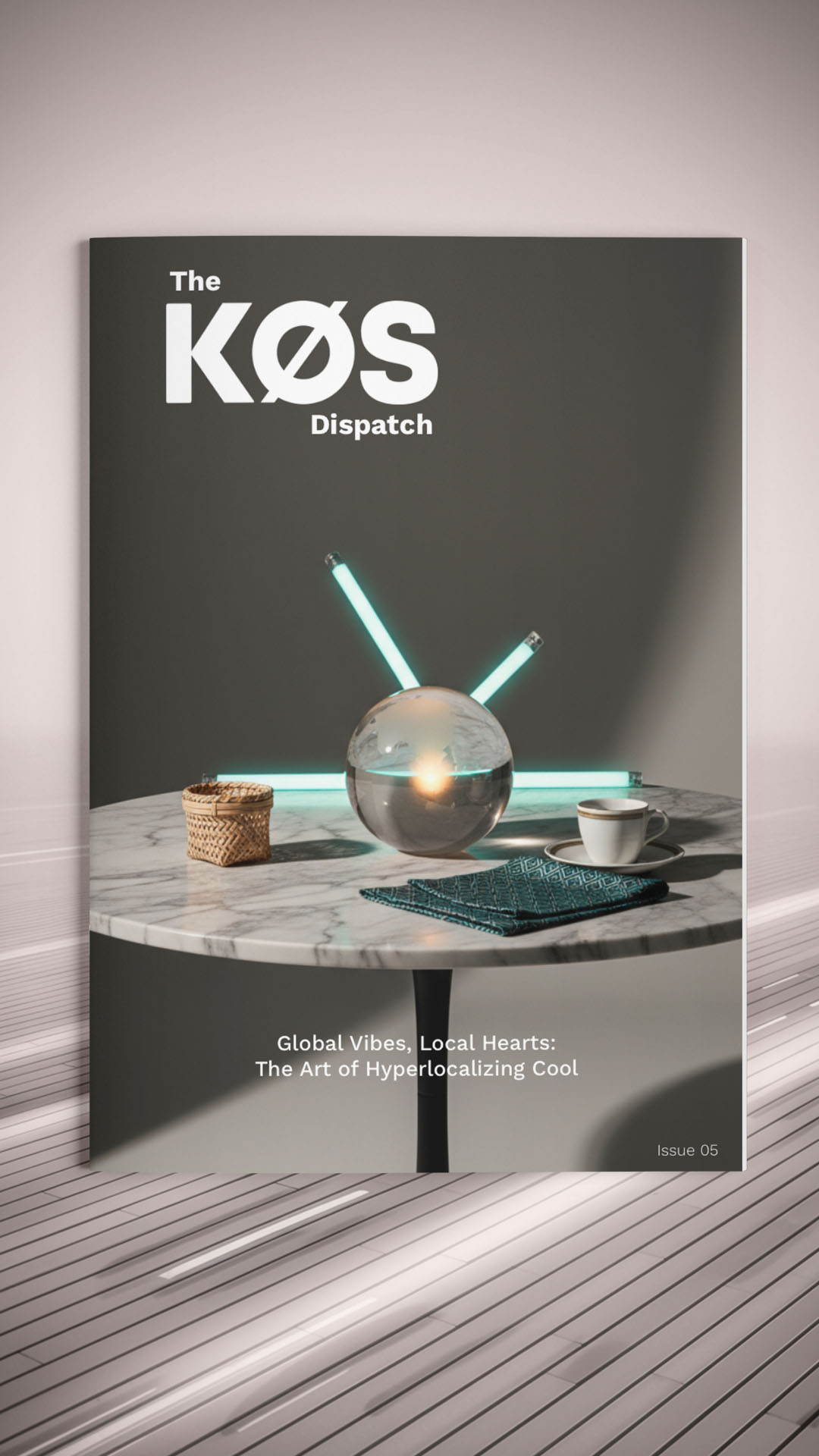
Letter from the Editor
I used to think cool was a universal language. Back when I was a teenager, I believed a pair of Nike sneakers or a can of Coke meant the same thing whether you were in New York or New Delhi. But experience has a way of shattering that naïve view. Last summer, wandering through the backstreets of Kyoto, I stepped into a Starbucks and found myself sitting on tatami mats, sipping a matcha latte in a century old townhouse. The signage was subtle, the décor unmistakably Japanese. It hit me. Even the biggest global brands win hearts one neighborhood at a time. Cool is not one size fits all. It is hyperlocal.
As the editor of KØS, I am obsessed with how culture and commerce collide. Nothing embodies that collision better than the trend we unpack in this issue, hyperlocalizing cool. Why does this matter to us at KØS. Because we believe brands are not just selling products. They are selling belonging. In a world where a streetwear drop in Seoul can spark a frenzy in Los Angeles, understanding local culture is not a nice to have. It is the difference between global fame and global indifference. Our readers, that is you, are creatives, marketers and change makers who will not settle for cookie cutter strategies. You want to build brands that respect the block as much as they dominate the globe. We are right there with you.
This letter is not just an intro. Consider it an invitation. In the pages that follow, we journey from Tokyo alleyways to African sports fields, from digital streaming platforms to mom and pop shops reinventing retail. We explore how global vibes can capture local hearts. Expect stories of brands that nailed the cultural code and cautionary tales of those that flubbed it. My hope is that you will see your own world in these stories. Maybe you will recall the first time a brand really spoke your language, perhaps literally. Or maybe you will get fired up to bring this hyperlocal mindset into your own work.
So grab a coffee, make it locally roasted, get comfortable and let us dig in. The world is big, but the little details matter more than ever. By the end of this issue, think global, act local will not just be a catchy phrase. It will be your operating system. Ready to redefine what cool means, one neighborhood at a time. Let us do this.
David Leuchter
Founder & Strategic Designer, KØS
What’s the Future?
Introduction
Welcome to the intersection of everywhere and right here. Global Vibes, Local Hearts is not just a slogan. It is a strategic mandate for brands in 2025 and beyond. We live in an era where a meme born in São Paulo goes viral in Seoul in minutes, yet a coffee shop around the corner still feels like a world of its own. The central theme of this issue is the art of hyperlocalizing cool, how globally ambitious brands can authentically resonate with local cultures. It is about taking worldwide trends and infusing them with the flavor, language and attitude of the neighborhood. It is about being the cool kid who speaks the local dialect, not an awkward tourist reading from a phrasebook.
Why does hyperlocalization matter so much now. Consumer expectations have skyrocketed. Surveys show that a clear majority of global consumers expect brands to understand their unique needs and cultural nuances. We are in the age of personalization. People can sniff out a generic, one size fits all message from a mile away. There have been some very public failures when brands got it wrong. Remember when Amazon launched its site in Sweden and littered it with embarrassing translation errors, even using the wrong flag in its marketing. The lesson was simple. Get local culture right, or do not show up. In contrast, brands that nail local vibes reap serious rewards. A large majority of online shoppers say they prefer products marketed in their own language, and many will not buy if the content is not localized at all. Language is the starting point. True hyperlocalization goes deeper, down to neighborhood slang, regional values, inside jokes and deeply held traditions.
What exactly is hyperlocalizing cool. Think of it as glocalization turned all the way up. Traditional localization might tweak a product or translate an ad for a country. Hyperlocalization goes further, sometimes down to a city, a district or even a single community. It is the difference between a pan India ad campaign and a campaign tailored just for Mumbai Gen Z college kids hanging out in Bandra. It is not just about avoiding mistakes. It is about creating magic that only happens when a brand really, truly gets the local culture. Done right, it feels less like marketing and more like belonging. Done wrong, it becomes a bad punchline on social media.
The stakes have never been higher. Get it right and you earn lifelong fans who feel seen and understood, the kind of loyalty money cannot easily buy. Get it wrong and you become an international joke, and these days the world laughs in unison on TikTok and Twitter. The good news. Brands now have more tools than ever, from data that pinpoints micro trends to local creative talent that can bridge cultural gaps, to make hyperlocal magic happen. In the chapters that follow, we spotlight several standout examples across industries and continents. These case studies show not just marketing tactics, but full cultural immersion. Each one is a story of a brand learning, listening and layering local cool onto global strategy.
By the end of this deep dive, a pattern emerges. Whether you are slinging sneakers or streaming shows, cool thrives at the hyperlocal level. Global success in this era is a mosaic of local victories. We start with those who have done it best.
Chapter 1: Starbucks
Brewing Local Flavor in Japan
If you wandered past it, you might not even realize it is a Starbucks. Tucked along a stone paved slope in Kyoto is a Starbucks store that looks like a traditional machiya townhouse, complete with noren curtains, tatami mat seating and a zen garden energy. This is not a cookie cutter coffee shop. It is a perfect illustration of how Starbucks, one of the most globally recognized brands, has learned to blend in without blending away.
When Starbucks first expanded to Japan, leadership knew that copy pasting the American formula would not cut it. So they hired local architects and designers to infuse Japanese culture into the very walls. Some Starbucks locations in Japan feature low slung roofs inspired by Shinto shrine architecture, tranquil courtyards with stone lanterns and water features and façades that harmonize with centuries old streets. The Kyoto Ninenzaka Yasaka Chaya store, set in a hundred year old townhouse, is the clearest example. From the outside, it looks like it has always been part of the neighborhood, aside from a discreet siren logo on the fabric curtain. Inside, thousands of wooden sticks crisscross the ceiling in a pattern echoing bamboo groves and temple carpentry.
This hyperlocal approach goes beyond looks. Starbucks in Japan tweaks its menu for local tastes, think matcha Frappuccino and seasonal sakura offerings. But design is where the brand shows it is not just in Japan, it is of Japan. Architecture becomes its own language. By using the visual vernacular of Kyoto old neighborhoods, Starbucks sends an unspoken message. We respect this place. We are part of this community.
The result. From day one, locals could feel that this café was not an invading alien Starbucks. It was their Starbucks. The cool factor here is subtle and powerful. It is the cool of fitting in. In a world of loud billboards and repetitive formats, Starbucks won Kyoto heart by whispering in a familiar architectural tongue.
The lesson. Making people feel at home with your brand sometimes means literally building a home that fits the neighborhood. It is easier to roll out identical prefab stores worldwide, but the stores that stand out are the ones that are rooted in the street they live on. Starbucks has tens of thousands of stores globally. It is the hyperlocal ones, like Kyoto, that people travel to see and share.
Chapter 2: Netflix
Going Local to Go Global
What do a Spanish mastermind in a red jumpsuit, a South Korean deadly children game and a French gentleman thief have in common. They all became global obsessions because Netflix learned how to hyperlocalize cool in its content strategy.
A few years ago, if you asked someone in the United States or Europe to binge a Spanish heist drama with subtitles, you would probably get side eye. Then came La Casa de Papel from Spain. Netflix picked it up, reedited and promoted it, and suddenly millions of non Spanish speakers were humming Bella Ciao and rooting for thieves in Salvador Dalí masks. Netflix did the same with South Korea Squid Game, turning a dark, satirical series steeped in Korean social commentary into a worldwide obsession. Lupin from France followed, with viewers everywhere falling for a modern gentleman thief navigating Paris.
These hits were not accidents. Netflix pivoted away from being a Hollywood export machine and started pouring real money into local productions across continents. They set up teams in Seoul, Madrid, Mumbai and beyond to find stories resonating in those markets and produce them with local talent and local writers. By now, a massive portion of the Netflix library is made up of foreign language titles. They are not afterthoughts. They are made by and for local audiences first, then allowed to travel.
Strategically, Netflix turned each country into a creative lab. If a show is a hit at home, chances are good it will connect with audiences elsewhere who are hungry for fresh voices. If it stays local, that is fine too, because it still deepens Netflix relationship with that market. In other words, global cool now comes from everywhere, not just from one creative capital.
The insight for brand builders. Authentic local stories can carry global appeal when given the right platform. Netflix did not force a single global formula onto these productions. They let locals lead as creative partners, then amplified what worked. That made Netflix feel like a champion of culture rather than a threat to it. In a world tired of copy paste entertainment, a show that speaks with a strong local accent feels fresh. Even if viewers watch it dubbed or subtitled, they can feel the specificity. That specificity is the point.
Your next big idea might not come from HQ. It might be hiding in a neighborhood scene or subculture that has never had a microphone. Netflix reminds us that going global often starts with taking a local bet very seriously.
Chapter 3: IKEA
Speaking Penang’s Language
How do you say welcome to the neighborhood without actually saying it. In Penang, Malaysia, IKEA did it with jokes in Hokkien, the local Chinese dialect. When the Swedish giant opened its store there, it did not just hang a Hello Penang banner. It went straight for witty, hyperlocal wordplay.
One billboard showed a chicken on one side and an IKEA cabinet on the other. The line read, we are not kay kia, we are IKEA. Kay kia in Hokkien means chick, a baby chicken, and it sounds like IKEA. Another ad showed a tall local guy next to a tall Billy bookcase. Caption. We are not lo kha kia. We are IKEA. Lo kha kia means tall kid or tall guy. It was simple, silly and instantly understandable to anyone who grew up hearing that dialect at home.
The campaign ran on billboards, print, social and digital. Locals shared the ads on WhatsApp and Facebook, tagging friends and laughing at how a global furniture brand had just nailed their inside jokes. Penangites are proud of their culture and dialect, which are not always front and center in national campaigns. Seeing Hokkien on a major brand billboard hit a nerve in the best way. It said, we see you.
Importantly, IKEA did not treat the dialect as a gimmick. The puns were accurate, playful and clearly crafted with care, likely with strong local creative partners. Get the nuance wrong and it would have felt insulting. Get it right and it is charming, even endearing.
Strategically, this is hyperlocalizing cool in its purest form. Instead of speaking standard global brand language, IKEA tuned its voice to the block. Language is not just a practical tool. It carries humor, identity and belonging. By sounding like a Penang neighbor rather than a distant multinational, IKEA built trust before a single flat pack box was carried out of the store.
The bigger lesson. To win local hearts, you need to speak the local tongue and ideally make people smile while you do it. It takes extra effort and sometimes a bit of courage. But when people feel that the brand gets them, the brand stops being foreign. It becomes part of the neighborhood wallpaper, in the best way.
Chapter 4: Coca Cola
Share a Coke, the Chinese Way
Personalization is cool. Personalization that respects your culture is next level. Coca Cola Share a Coke campaign, where bottles feature people first names, is a modern classic. In China, Coca Cola reimagined the idea and created something that felt uniquely Chinese.
Instead of printing first names on bottles, Coke printed affectionate nicknames and titles that people actually use daily. Chinese naming culture is different to Anglo culture. Friends are more likely to use playful titles than given names. So shelves filled with bottles that read close friend, goddess, study ace, best bro and so on. These were the words Chinese youth already used in chats and messages.
The magic was in the emotional fit. Buying a Coke for your crush labeled goddess or for your top student friend labeled study hero suddenly felt deeply personal. The bottles became small tokens of relationships, not just containers of soda.
Coca Cola plugged this into China digital life by partnering with platforms like WeChat and QQ so people could create virtual Coke bottles with custom nicknames and share them. Suddenly feeds were full of virtual cans and bottles sent between friends and couples. The physical and digital campaigns reinforced each other. Sharing a Coke went from a nice idea to a cultural moment.
The results were big. Sales jumped sharply during the campaign period and Coke enjoyed a surge in brand love with younger consumers. Just as important, the brand proved it understood that a copy paste version of a Western idea would not land the same way in China. Instead of forcing first names, they asked what sharing a Coke really looks and feels like in local social life, then designed for that feeling.
For any global brand, the takeaway is clear. Translation is not enough. You often need transcreation. Keep the core idea, in this case sharing, connection and small gestures of affection, and redesign the execution to match local norms and language. Sometimes that even means removing your own name from the front of the packaging and letting the relationship take center stage. That is a brave move. It is also very effective when done well.
Chapter 5: Snickers
One Global Slogan, Dozens of Local Twists
You are not you when you are hungry has become advertising legend. What made the Snickers campaign truly iconic was not just the line. It was the way that line traveled and shape shifted across more than fifty markets without losing its soul.
In the United States, the campaign launched with Betty White getting tackled in a muddy football game. She only turned back into a young player once she ate a Snickers. It was funny, surprising and instantly shareable. In Australia, Snickers built the Hungerithm, an algorithm that tracked online anger levels and dropped Snickers prices at 7 Eleven whenever the internet seemed especially hangry. The angrier the internet, the cheaper the bar. It was smart and very on brand for a country that loves cheeky tech experiments.
In Puerto Rico, the campaign took over radio. Popular DJs started behaving out of character on air, playing the wrong music or talking in strange tones. After confusing listeners for a bit, Snickers revealed that the DJs were just hungry and not themselves. The punchline tied back to the slogan and gave radio fans a laugh. In the United Kingdom, Snickers joined a live cultural moment by tweeting at a TV host involved in a scandal, suggesting he might not be himself when hungry. The tweet rode a wave of conversation and injected the brand into the news cycle with perfect timing.
What holds all of this together is a simple human truth. Hunger makes people act unlike themselves. That truth is global. The executions were hyperlocal. Each market leaned into its own humor, media habits and cultural references. Snickers and its agency partners did not rigidly insist on the same ad everywhere. They treated the slogan as a flexible platform and let local teams reinterpret it.
The result. The campaign stayed fresh for years, felt relevant almost everywhere and gave Snickers serious cool points with both consumers and the ad industry. It is a benchmark example of global idea, local spin thinking. One melody, many remixes.
There is a bigger strategic principle here. You do not have to choose between global consistency and local creativity. You can design for both. Start with a strong insight and clear brand point of view. Then trust local partners to express it in their own way. When you do that, a single line can become a world tour instead of a one hit wonder.
Conclusion
The Local Is the New Global
From Kyoto cafés to Penang billboards, from Paris thieves to Chinese nicknames, one truth keeps resurfacing. Brands earn their cool not by shouting louder but by listening closer. Hyperlocalizing is not about superficial translation or decorative details. It is about humility, recognizing that culture is built in kitchens, on street corners, in slang and in everyday rituals. It is about creativity, taking those fragments and weaving them into global stories that still feel personal when they land.
The irony. The more local a brand dares to go, the more global it can become. Netflix proved it with Spanish heists and Korean game shows. Snickers did it by letting humor speak in dozens of dialects. Consumers do not reward ubiquity. They reward intimacy. In today noise, specificity, subtlety and even silence can be the boldest moves.
For leaders, the mandate is clear. Stop thinking in continents and start thinking in corners. If your brand can genuinely belong on a single street, it can scale to the world. That is the paradox and the promise of hyperlocal cool.
So the real question is not whether you can globalize your idea. The real question is whether you can make it matter on your block.
Key Takeaways
Be a cultural sponge.
Before you try to be cool, understand what cool means here. Do your homework on local culture, humor, values and taboos. Hire local designers, talk to locals, immerse yourself in street slang. Authenticity starts with listening, not with a template.
Empower local teams.
Your brand might be global, but your execution should be local. Empower local teams or creative partners to adapt or even reinvent your ideas. They know what their community cares about. Trust them to tweak the formula.
Adapt more than language.
Translation is not transformation. Hyperlocal means you may need to adjust visuals, packaging, flavors, store design and formats to reflect local tastes. A burger can become a paneer patty. A café can become a tatami room. The principle is the same. Align the offer with lived reality.
Keep the core, flex the execution.
A strong global brand idea or slogan gives you a backbone, like Snickers hunger truth. But do not be rigid. Think of your brand as a song with a solid melody. Let each market remix it in its own genre. The core message stays clear while locals feel real ownership.
Prioritize community over campaigns.
The best hyperlocal strategies do not feel like campaigns. They feel like community. Starbucks blending into a heritage street, a sports brand backing a local tournament, a retailer embracing neighborhood dialect. Aim to become part of the local fabric, not just a logo on a poster.
In the end, hyperlocalizing cool is where respect and imagination collide. Respect for each place uniqueness. Imagination to craft something special for it. It is not the easiest path, it demands extra effort, openness and a few bold leaps of faith. But the rewards are heavy. Customer love, cultural relevance and the kind of loyalty that no discount code can buy.
kos.wtf · @kos.is.now · hello@kos.wtf
